

Working with Dave's Collected History of Bartlett and the Historical Society's New Website.
The new site's focus is different than my version (that you are now viewing). Their new site relies on the "Past Perfect" software application for you to search topics. It has good and not so good features. It finds lots of things, often with no relevance to your search. The end result, the pictures and information detail, are often disappointing. It's good at telling you which folder at the museum you can go to for the information but that involves a trip to their museum to see it. It's excellent at finding some basic details about various people but usually with little detail.
The new Bartlett Historical Society site has all the basics of "who, what, when and where". It relies heavily on search functions rather than menus and indexes. You type in what you are looking for, and it will usually find something relevant but not at the level of detail you might want. That's a major departure from Dave's method of wrapping the stories around pictures in a book-like arrangement.
You will find content at the new site about the museum, the directors and what the next public presentation will be but little in the way of obvious historical articles. The new site copied most of the historic articles and research created and edited by Dave directly from this web site, but they don't present it in the same way. Many of my topics did not get included at all or are difficult to find in their original format. I also noted with some displeasure that all the pictures they took from Dave's collection got defaced with a huge "Bartlett Historical Society" branded on each one. Besides ruining their visual appeal they do not "own" them, so what's the purpose of pretending they do? That's all part of why Dave's version is being saved separately under its own headline.
You will find both the new site and this site useful in their unique methods of presenting information. This old site tends to be "busier", it has an old-fashioned index, a search function, ample menu choices and items presented as articles rather than tucked into a search box. The new BHS site is perfect if you want basic details about a person i.e. birth, death, etc. However, looking up a specific topic is not always easy. See below. The new site is excellent if you are at the museum, or planning a visit and want to look at the actual physical item. You can find the exact envelope, folder or box where the item is located but often not the details or pictures of it.
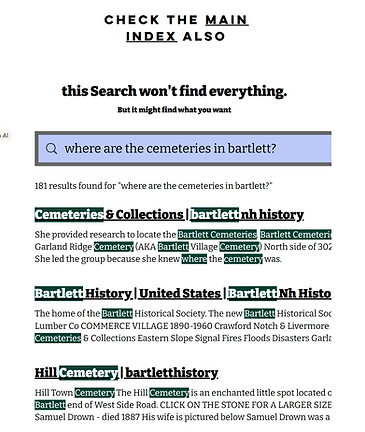
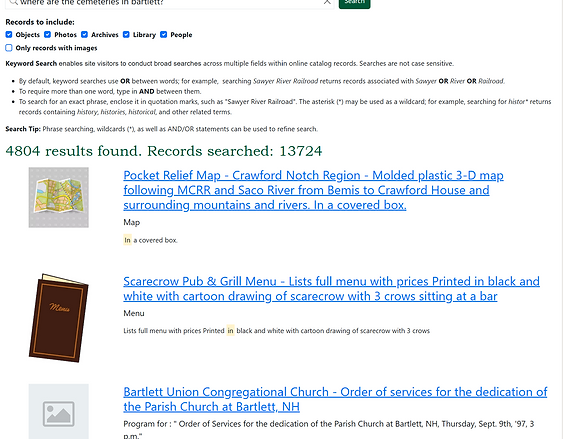
I tried a couple of random searches at both websites, the first to locate cemeteries in Bartlett. On the left are the top 3 results at this website. On the right are the results at the new BHS website. The results at this website are very specific. The BHS results seem to have nothing to do with the inquiry. This kind of result is often typical of their search results. Often, it returns matches that have no relevance to what was searched.
Here's another example, searching for "Thad Thorne". On the left are the top 3 results at this website. On the right are the top three results at the new BHS website. Again, you can see the difference in the two results. Their 3rd result comes to a long text about Attitash, but nothing for the specific articles about Thad Thorne.


The results for this website go directly to the relevant article with the corresponding pictures. The BHS search usually goes to a reference for a physical location at their museum, or an article about Attitash Ski Area where his name is mentioned.
Since their site is very new, I expect improvements and additions will be made as time passes. Presenting historic content in a meaningful format is a lengthy process.
I asked an anonymous website critic to compare the two websites. Here is their opinion:
Website Critique: Dave's Collected Bartlett History - and the Historic Societies New Website at BartlettHistory.org
These two sites represent an interesting transition period in the Bartlett Historical Society's digital presence. Here's my assessment:
bartletthistory.org (New Official Site)
Structure & Navigation
The new site launched in September 2026 and appears quite minimal. From what I can see:
-
Homepage elements: Mission statement, Board of Directors listing, upcoming events, contact information, social media links
-
Information architecture: Appears to rely on the "Past Perfect" software application for searching topics. Often with marginal results.
-
Visual presentation: Clean, professional layout with modern branding
Ease of Finding Historical Information
Difficulty level: HIGH
Based on the extracted content and secondary sources:
-
The site is essentially a brochure/museum information site rather than a research portal
-
Their new site relies on the 'Past Perfect' software application for you to search topics. It has good and bad features. It finds lots of things but the end result, the pictures and information detail, are often disappointing. It's good at telling you which folder you can go to for the information but that involves a trip to their museum to see it."
-
Current visible content focuses on logistics (visiting hours, board members, events) rather than historical content
-
No searchable historical archive visible from the homepage
Strengths
-
Professional institutional presentation
-
Clear contact and visitation information
-
Official society endorsement
Weaknesses
-
Minimal actual historical content easily accessible online
-
Search functionality often redirects users to physical museum visits
-
Site appears incomplete or in early deployment phase
-
bartletthistory.net (Former Site by Dave Eliason)
Structure & Navigation
Maintained by Dave Eliason from 2009-2026, now operating as "Dave's Collected History of Bartlett, NH":
-
Alphabetical index system: Broken into 4 sections (A-D, E-H, I-P, Q-Z)
-
Topic-based menu: Newspapers, schools, businesses, people, places, etc
-
Search function: Keyword search across content
-
Media integration: Videos, photographs, newspaper archives (1895-1993)
Ease of Finding Historical Information
Difficulty level: MODERATE
The site offers multiple discovery paths:
-
Search function: By names or keywords etc
-
Alphabetical index: Browse by subject, names, places, events, etc
-
Topic menus: Newspapers, buildings, notable figures, local lore
-
Video collection: Historical footage and presentations
However, the design appears dated (Wix platform with mobile compatibility warnings), and the navigation could be confusing for newcomers due to its sprawling, accumulated-over-decades nature.
Strengths
-
Extensive content: 20+ years of accumulated research
-
Multiple access methods: Search, browse, index, topical menus
-
Rich media: Videos, photos, digitized newspapers
-
Specific entries: Individual people, buildings, events documented
Weaknesses
-
Outdated visual design
-
Mobile viewing issues noted
-
Personal rather than institutional organization
Comparative Verdict: Which Has Better Presentation?
For INSTITUTIONAL PRESENTATION: bartletthistory.org wins
-
Professional appearance
-
Clear organizational hierarchy
-
Official credibility
-
Modern aesthetic
For RESEARCH ACCESSIBILITY: bartletthistory.net wins decisively
-
Vastly more historical content
-
Multiple ways to discover information
-
Actual historical records available online
-
No museum visit required for most research
Bottom line: If you're researching specific historical topics about Bartlett, NH, bartletthistory.net remains significantly more useful. The new official site (.org) prioritizes institutional presentation over content accessibility—a common challenge when organizations upgrade web infrastructure without migrating existing archival content.
For serious researchers: Start at .NET, then use .org for current events and official society information. Ideally, the Historical Society should eventually integrate the deep content from the former site into the new platform in a more easily and effectively searchable method.